Category: Rants

  • What is Culture?

    As I am often in contact with people from all around the world, sometimes I am asking myself: what makes a “culture” – geography, history, language, politics, belief system?

    I can in principle agree with the Wikipedia definition (a bit convoluted though)…

    Culture is a concept that encompasses the social behavior, institutions, and norms found in human societies, as well as the knowledge, beliefs, arts, laws, customs, capabilities, attitudes, and habits of the individuals in these groups. Culture often originates from or is attributed to a specific region or location.

    World Values Survey

    Recently I ran into the “World Values Survey” website, that really gave me a new understanding of how a culture can be defined and even compared.

    The WVS has over the years demonstrated that people’s beliefs play a key role in economic development, the emergence and flourishing of democratic institutions, the rise of gender equality, and the extent to which societies have effective government.

    Inglehart–Welzel Cultural Map

    The map presents empirical evidence of massive cultural change and the persistence of distinctive cultural traditions. Main thesis holds that socioeconomic development is linked with a broad syndrome of distinctive value orientations. Analysis of WVS data made by political scientists Ronald Inglehart and Christian Welzel asserts that there are two major dimensions of cross cultural variation in the world:

    1) Traditional values versus Secular-rational values and

    2) Survival values versus Self-expression values.
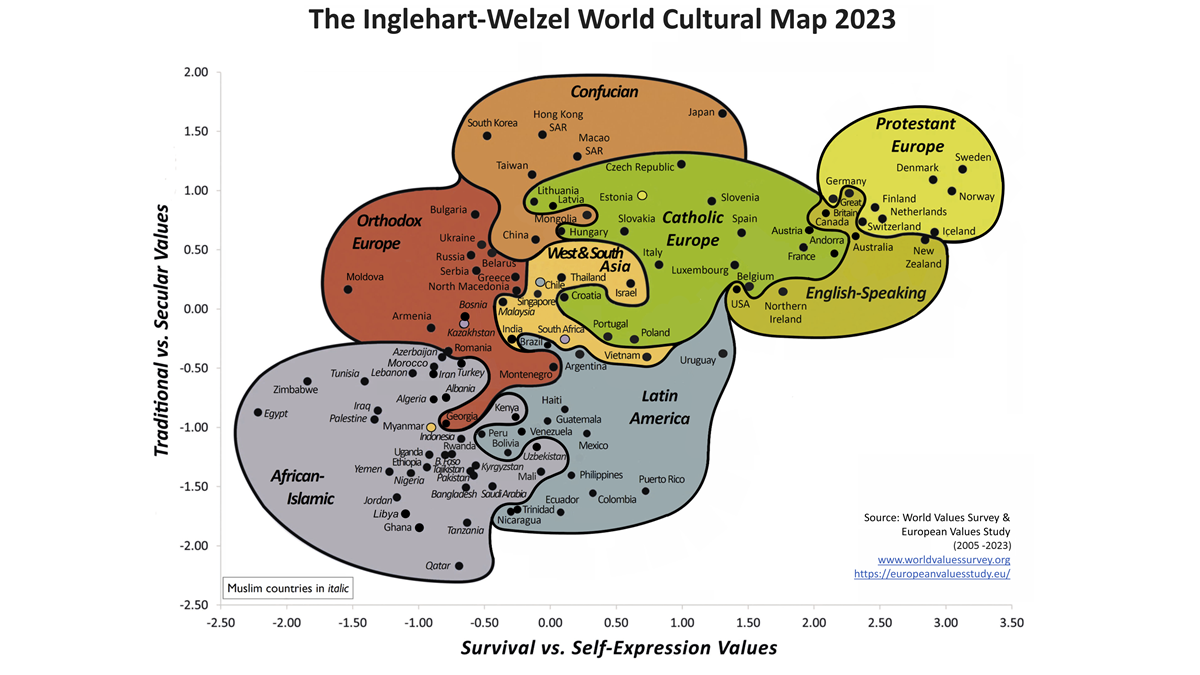
    WVS Database – Findings and Insights

    Any thoughts?
  • Technical debt and vibe-coding

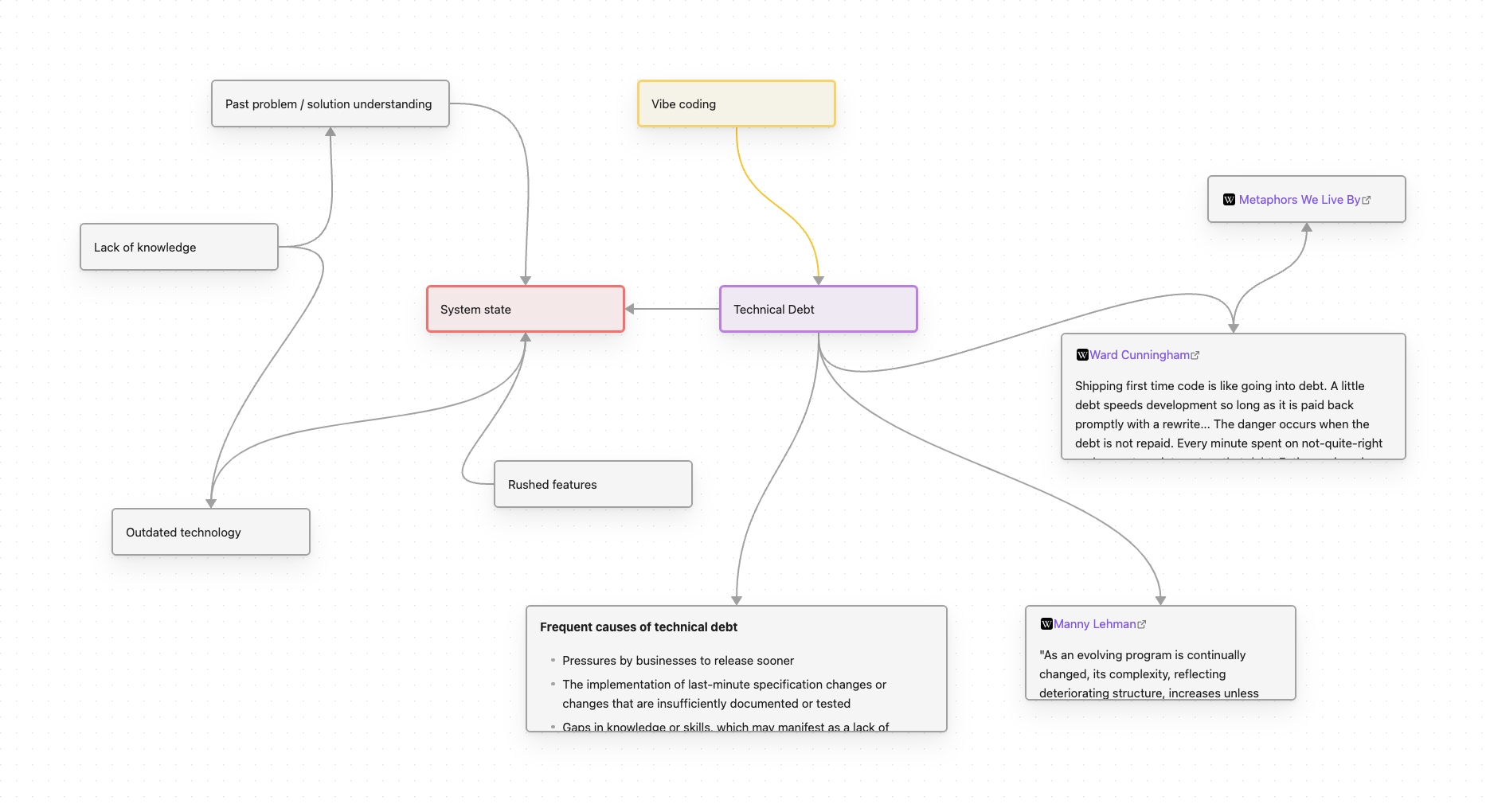
    When looking at any system as-it-is, my perspective remains: tech debt is the state of a system that captured the understanding of the problem when it was created and doesn’t fully reflect today’s understanding.

    The (obsolete) understanding applies to both functional and non-functional requirements, so it might be about the business, technical, scaling, or another aspect of that system (also organizational).

    This might NOT help with “business” understanding what is meant by “tech debt”, but put it in terms of business understanding embodied in code, you might stand a chance to affect the roadmap.

    Don’t forget – we will still produce (some) technical debt for the future as soon as the business or operational requirements change.

    And, yes, vibe-coding will produce a lot of technical debt. Slop is not long-term.

    Inspired by the exchange on LinkedIn.

    Knowledge map

    Additional references

    Quote: Technical Debt

    Shipping first time code is like going into debt. A little debt speeds development so long as it is paid back promptly with a rewrite… The danger occurs when the debt is not repaid. Every minute spent on not-quite-right code counts as interest on that debt. Entire engineering organizations can be brought to a stand-still under the debt load of an unconsolidated implementation, object-oriented or otherwise.

    — Ward Cunningham

    https://en.wikipedia.org/wiki/Technical_debt

    https://de.wikipedia.org/wiki/Technische_Schulden (German article is quite different and worth reading)

    Quote: Vibe coding

    … a chatbot-based approach to creating software where the developer describes a project or task to a large language model (LLM), which generates code based on the prompt. The developer does not review or edit the code, but solely uses tools and execution results to evaluate it and asks the LLM for improvements.

    https://en.wikipedia.org/wiki/Vibe_coding

  • Current stream of thought: revenues vs. market cap

    The financials here make absolutely no sense to me, and this is only an example of the current state of (US) economy?


    Zoom market cap is currently close to $107 billion, and it announced on July 18. 2021 that it’s acquiring Five9 for $14.7 billion in stock.

    Meanwhile, Zoom reported net income of $7.6 million on revenue of $331 million for the year ended January 2020.

    (Source)


    For sure their success is fascinating, and no small feat, but how is it ever expected that it measures in such a sky high evaluation?

    Is the bubble real, or just late capitalism manifestation?

    Or are they embodiment of the same religion, capital worshipping on the altar of ever transforming bubble.

  • New times, new words

    New times, new words


    The devices that are taking away our attention are increasingly present in our daily lives. Smartphones, tablets, watches, glasses. This alters human behavior, altering the language as well.

    (more…)

  • All the levels of redirection

    The web is full of redirection these days.

    (Warning, a bit of a rant going on here)

    I read a lot of content on my phone, and started to notice how much I am redirected around. This is something one usually doesn’t notice on a computer, since the connection is much faster, and I guess the browser renders in a different way.

    (more…)