Category: Encounter

  • AI Economics for Dummies – McSweeney’s Internet Tendency

    4. Benjamin owns a farm. He employs 100 workers plowing his fields. His total payroll is $10 million/year. One day, he buys a mule, which provides the worker who uses it with a modest 10 percent productivity gain. Benjamin fires 99 of his workers and purchases 99 mules, expecting a 1,000 percent productivity gain. The driverless mules cause plow damage to his property in excess of $50 million. Benjamin loses another $5 million due to the loss of productivity from his one remaining employee, who no longer guides a plow but instead spends 100 percent of his time shoveling mule shit. Goldman Sachs builds an altar to Benjamin in their lobby and cuts out the heart of a junior analyst on it every Friday. They call it “Blood Sacrifice Friday.” The name isn’t catchy, but the event becomes a management favorite nonetheless.

    Source: AI Economics for Dummies – McSweeney’s Internet Tendency

  • What is Culture?

    As I am often in contact with people from all around the world, sometimes I am asking myself: what makes a “culture” – geography, history, language, politics, belief system?

    I can in principle agree with the Wikipedia definition (a bit convoluted though)…

    Culture is a concept that encompasses the social behavior, institutions, and norms found in human societies, as well as the knowledge, beliefs, arts, laws, customs, capabilities, attitudes, and habits of the individuals in these groups. Culture often originates from or is attributed to a specific region or location.

    World Values Survey

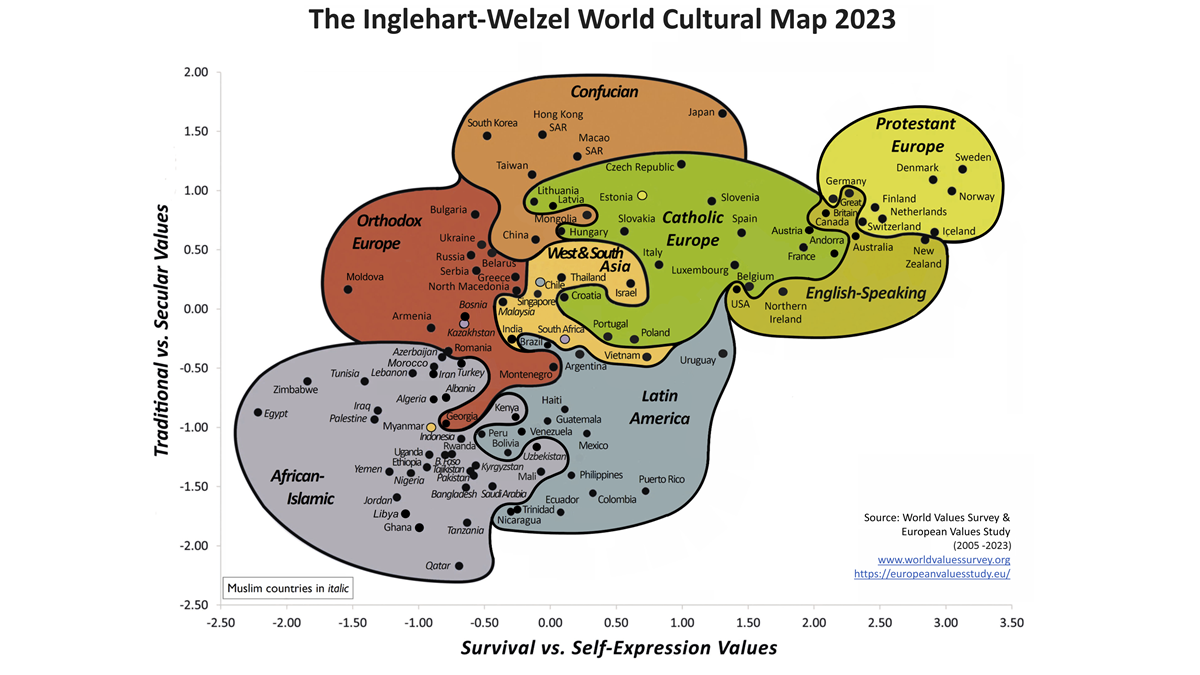
    Recently I ran into the “World Values Survey” website, that really gave me a new understanding of how a culture can be defined and even compared.

    The WVS has over the years demonstrated that people’s beliefs play a key role in economic development, the emergence and flourishing of democratic institutions, the rise of gender equality, and the extent to which societies have effective government.

    Inglehart–Welzel Cultural Map

    The map presents empirical evidence of massive cultural change and the persistence of distinctive cultural traditions. Main thesis holds that socioeconomic development is linked with a broad syndrome of distinctive value orientations. Analysis of WVS data made by political scientists Ronald Inglehart and Christian Welzel asserts that there are two major dimensions of cross cultural variation in the world:

    1) Traditional values versus Secular-rational values and

    2) Survival values versus Self-expression values.

    WVS Database – Findings and Insights

    Any thoughts?

  • First online article on technical debt

    Ward Cunningham introduced the metaphor underlying the term technical debt in a 1992 experience report, where he described how his company incrementally extended a piece of financial software:

    Shipping first time code is like going into debt. A little debt speeds development so long as it is paid back promptly with a rewrite. Objects make the cost of this transaction tolerable.

    The danger occurs when the debt is not repaid. Every minute spent on not-quite-right code counts as interest on that debt. Entire engineering organizations can be brought to a stand-still under the debt load of an unconsolidated implementation, object- oriented or otherwise.


    https://c2.com/doc/oopsla92.html

    via

    https://ieeexplore.ieee.org/stamp/stamp.jsp?tp=&arnumber=10109339 (PDF)

  • Web Design Museum – Discover old websites, apps and software

    Web Design Museum exhibits thousands of websites that chronicle forgotten trends in web design from its beginnings in the 1990s to the mid-00s.

    Source: Web Design Museum – Discover old websites, apps and software

  • The Web We’ve (Never) Lost

    Posted on July 28, 2024 by Jan Vlnas

    Based on my talk for PragueJS meetup from February 2024

    Source: The Web We’ve (Never) Lost

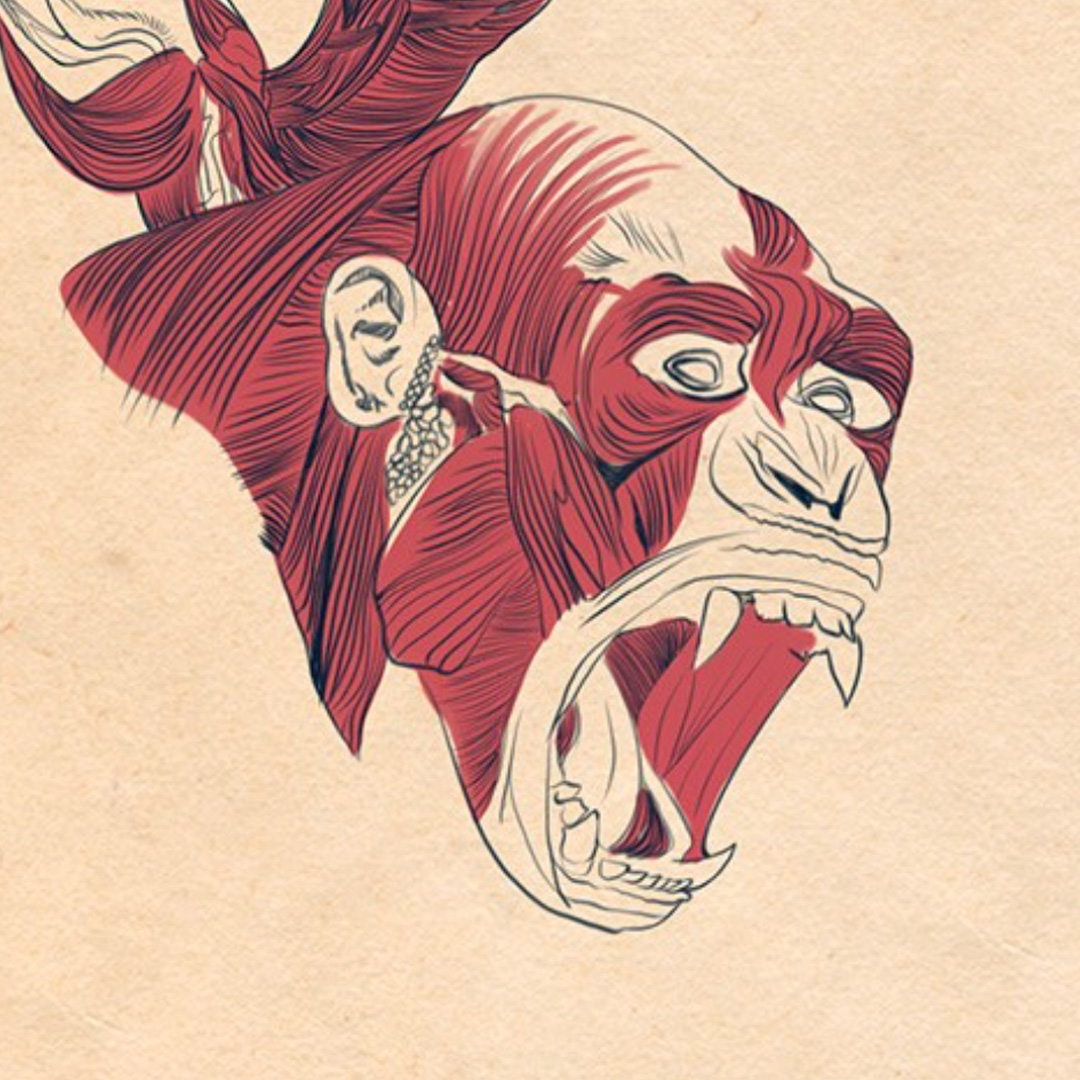
  • Kingdom Animalia

    What if animals would try the human race and our impact on the planet?


    Welcome to the last days of humanity! Watch as our glorious species fights for its existence against dangerous, violent creatures who want nothing more than our total destruction! Even the cute animals don’t like us and that really hurts, you know?

    Source: Kingdom Animalia

  • The Three Oddest Words

    The Three Oddest Words

    When I pronounce the word Future,
    the first syllable already belongs to the past.

    When I pronounce the word Silence,
    I destroy it.

    When I pronounce the word Nothing,
    I make something no non-being can hold.

    Wisława Szymborska


    .. So beautiful.

  • Refresh: RFC 9110: HTTP Semantics

    The Hypertext Transfer Protocol (HTTP) is a stateless application-level protocol for distributed, collaborative, hypertext information systems. This document describes the overall architecture of HTTP, establishes common terminology, and defines aspects of the protocol that are shared by all versions. In this definition are core protocol elements, extensibility mechanisms, and the “http” and “https” Uniform Resource Identifier (URI) schemes. This document updates RFC 3864 and obsoletes RFCs 2818, 7231, 7232, 7233, 7235, 7538, 7615, 7694, and portions of 7230.

    Source: RFC 9110: HTTP Semantics

    Additional: IETF